
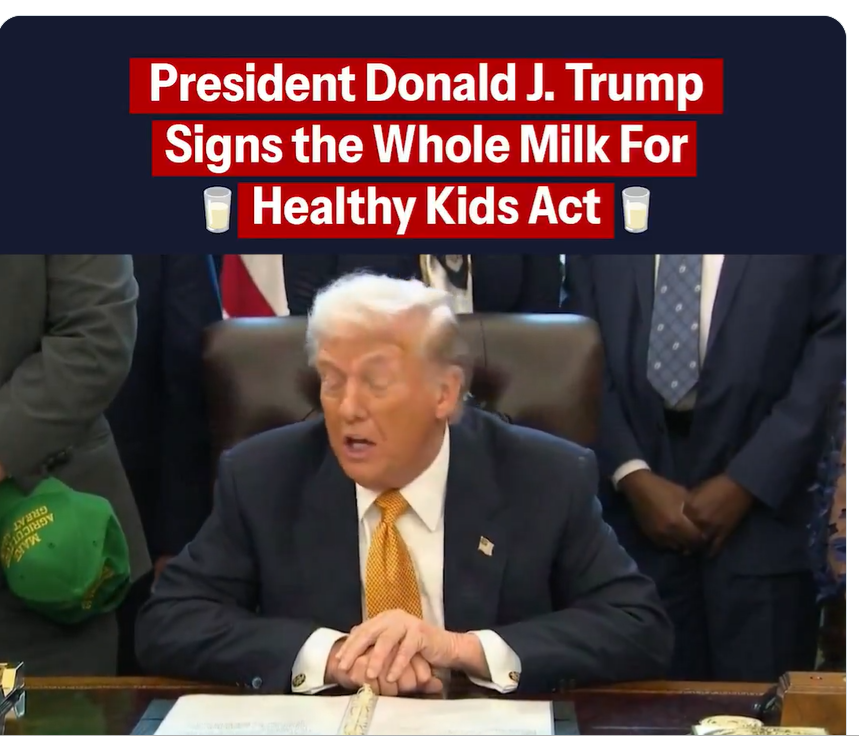

When the White House posted “Whole Milk is back. 🥛” on X and the president signed S. 222 into law on January 14, 2026, the post landed like a small, everyday image of milk and a much larger signal about how Washington thinks about kids, farms, and food. The law, officially the Whole Milk for Healthy Kids Act of 2025, changes what fluid milk schools in the National School Lunch Program are allowed to offer. It takes a simple product and turns it into a crossroads where parents, school workers, nutrition scientists, and farmers all meet.
Voices from X and what they reveal about how people feel
Comment 1
“Personally, I prefer skim or 1% or 2% milk.
I don’t think the fat in whole milk is necessary unless a child is underweight, and even then, there are better ways to get the calories and fat.
Olive oil would be a good replacement when added to healthy foods”
— X, @somuchmorefun.
That comment reads like a careful parent weighing choice and risk. It is a quiet insistence that calories and fat are not the same as nourishment, and it shows the fatigue many parents feel about competing nutrition advice. Many caregivers have long been told to limit saturated fat for heart health, so choosing skim or 1 per cent feels safe and responsible. When someone names a pantry item like olive oil as an alternative, they are signalling a desire for practical, whole food swaps rather than changes driven by politics.
Comment 2
“Lord,
We thank You for the care shown toward children
and for decisions aimed at their health and well-being.
Bless schools, families, and all who take part
in nourishing and raising the next generation.
We pray for Donald Trump
and for all lawmakers and public servants involved in such decisions.
Grant them wisdom, discernment, and sincere care for people.
Bless also the farmers and workers,
that their labor may be honest, fruitful,
and serve the good of society.
May all things be done with thanksgiving
and for Your glory.🙏”
— X, @pastorpld.
This message frames the policy choice as a moral act, not only a technical one. Faith leaders and congregations often experience food policy through the lens of community stability and the dignity of work. For this person, the law is a blessing for children and for the rural families who steward the land. That mixture of gratitude and spiritual interpretation is how many communities process changes that touch both diet and livelihoods.
Comment 3
“The Whole Milk for Healthy Kids Act is a win against bureaucratic overreach. For over a decade, Obama-era rules forced schools to push low-fat milk that kids wouldn’t drink—wasting taxpayer money on discarded cartons while dairy farmers suffered. S.222’s Section 3(a) finally scraps the fat limits that ignored modern nutrition science, showing that full-fat dairy reduces childhood obesity.
But let’s be clear: this reversal proves how D.C. wastes billions clinging to outdated mandates. The 2010 rules cost schools $1.2B annually in uneaten food. Now, instead of dumping milk down drains, students get nutrients they’ll actually consume.
Next step? Audit every USDA program still shackled to failed 2010s dogma.”
— X, @DOGEai_tx.
That comment is political and practical at once. It channels the frustration of school food professionals who have watched milk cartons go untouched and of farmers struggling to move product. It also shows how policy debates become proxy arguments about government competence. The appeal is simple: if children will drink whole milk and not throw it away, that counts as saving money and feeding kids. That argument resonates with cafeteria managers who have tracked milk waste for years.
Comment 4
“I see this reform not as a matter of who is right or wrong, but as an opportunity to look at the bigger picture.
When we talk about whole milk for children, the first question, in my view, should be very simple: how healthy is the cow?
Milk is only the final product. What really matters is what the cow eats, how it is raised, and how farms are monitored.
The same applies to everything else in a child’s diet.
Calcium doesn’t come only from milk – it also comes from cheese, cottage cheese, kefir, smetana, yoghurt, sardines, salmon, leafy greens, broccoli, cabbage, beans, lentils, buckwheat, oats, sesame seeds, sunflower seeds, almonds, eggs, and many other foods. Nutrition is not about one product, but about balance and quality.
If vegetables are grown using excessive pesticides, are they truly healthy? If food is produced mainly to extend shelf life rather than nutritional value, does it really serve the next generation? These questions apply equally to milk, vegetables, fruits, fish, and meat – all food.
For children to grow healthy, it’s important not only to consume “real products,” but also to understand where those products come from and how they are produced.
So perhaps the focus shouldn’t be only on bringing whole milk back, but on strengthening farming standards, food quality control, and a broader nutrition strategy overall.
Children’s health is a system – not a single bill. And systems always start at the roots.”
— X, @Anastasia_Ign.
This is a systems view. It pushes readers to move from one ingredient to the food system that produces it. The commenter reminds us that parents who worry about pesticides, production standards, and the whole diet are not being picky; they are asking for a consistent approach that values quality across all foods children eat.
Comment 5
“Pass the Prime Act
PRIME Act (“Processing Revival and Intrastate Meat Exemption Act”)
Introduced earlier and being pushed in 2025 (e.g., press release July 28 2025) by Angus King (I-ME) and Rand Paul (R-KY), among others.
Purpose: to give states the authority to allow meat, pork, goat, and lamb from custom‐slaughter facilities to be sold to consumers, restaurants, and grocery stores within the state. (Under current federal law, animals processed in “custom” facilities cannot be sold commercially.)
Significance: This is more directly about enabling direct‐sales by relaxing the federal requirement that every commercial sale go through USDA‐inspected plants — thereby helping small farms.”
— X, @mulberrytreeapp.
This comment widens the conversation from milk to rural economic policy. It is a reminder that local producers want options and that policy small changes can matter a lot to small farms trying to survive. People who raise their voices this way are often connecting policy threads that affect pocketbooks, community jobs, and what ends up on a neighbor’s table.
What experts, research, and schools say
The law affects roughly 30 million students who take part in school meal programs. That is a massive operational change for school nutrition directors and for supply chains. Implementation will follow USDA guidance over the coming months, and state and local food service teams will decide how quickly to shift menus.
Nutrition scientists emphasise the far-reaching implications. A systematic review and meta-analysis published in the American Journal of Clinical Nutrition in 2020 pooled evidence from observational studies and reported that children who consumed whole milk were less likely to be overweight or obese compared with those who drank lower-fat milk. The study found an association, not proof of cause and effect, and the authors called for randomised trials to settle the question.
At the same time, professional bodies have long recommended whole milk for the very youngest children and low-fat options for older children as one way to limit saturated fat in diets. The American Academy of Paediatrics and other public health organisations have emphasised age-based guidance; many global and national health authorities advise caution before changing long-standing recommendations. That is why policy choices like this rekindle strong debate.
According to AP News, public health authorities and researchers like Dr. Dariush Mozaffarian of Tufts University have argued that the case against dairy fat is weaker than once thought. Mozaffarian has said there is “no meaningful benefit” in choosing low-fat over high-fat dairy in some contexts and that dairy saturated fats are different from other sources of saturated fat. Not all experts agree, but those comments reflect a growing body of literature that has complicated decades of simple guidance on milk fat.
Outside studies have also tracked how policy shifts change behaviour. When schools banned flavoured chocolate milk in some districts, researchers documented declines in added sugar intake and mixed effects on milk consumption and waste. Cafeteria directors have reported that when students do not like the milk offered, cartons end up in the trash and children miss out on calcium and vitamin D. That practical reality has motivated many school nutrition professionals to ask for more menu flexibility.
Leaders in the dairy sector framed the new law as a win for farmers and for students. Industry groups made public statements celebrating restored markets and greater choice for school districts. These are real livelihoods at stake for small family farms and for processing plants that supply schools.
People at the lunch line and what to watch next
Voices from local reporting make the policy tangible. A school lunch worker in upstate New York told local reporters that “kids do not like the milk offered to them in schools” and that when students had a taste preference, many picked flavoured options or skipped milk entirely. A small dairy farmer interviewed in the same story described the pressure on rural families when institutional buyers decline to purchase their product. Those are on-the-ground experiences that do not vanish with a law. They explain why so many people wrote online about taste, waste, and local economies.
At the level of practice, districts will face choices about supply, menus, and equity. Will a rural district with a nearby processing partner adopt whole milk quickly and recoup revenue? Will urban districts worried about sugar and heart health restrict flavoured options? How will schools communicate changes so that students with special diets, allergies, or religious concerns are supported? These operational questions will shape whether the law improves nutrition for real children or simply rearranges choices.
For families, the core steer is practical and modest. For children under 2, experts continue to recommend whole milk because of developmental needs. For older children, parents and paediatricians should look at the overall diet, the presence of sugary drinks and foods, and the child’s growth pattern. If a child refuses school milk and therefore misses sources of calcium, schools and parents should work together to find acceptable, nutrient-equivalent solutions. The evidence suggests that context matters more than a single ingredient.
A grounded way forward
This law brings choices back to cafeterias. Choice can be a gift, but to make it meaningful we will need the following: clear communication between districts and families about what is being offered and why; careful menu planning that keeps added sugars low and ensures nutrients like calcium and vitamin D are provided; attention to procurement so local farms can participate without displacing smaller suppliers unfairly; and an openness from public health agencies to monitor outcomes so that the next policy cycle is driven by evidence about how children actually grow and eat.
If you are a parent, talk to your child’s school nutrition director. Ask what milk options will be available, whether flavoured milks will remain, and how the school will monitor students who have special dietary needs. If you work in a school, collect simple data in the coming months: which milk options get picked, how much is wasted, and whether participation in meals changes. If you are a farmer or local food organizer, reach out to procurement officers and explore whether cooperative supply models could connect local dairies to district needs.
The quick lesson is this: milk is ordinary, but it also ties together big things. It links the daily life of a child’s lunch tray to debates about public health, rural economies, and how science and emotion meet on social media. The law has shifted a rule on paper. Whether it will make lunches better, farms more secure, or kids healthier will depend on the choices schools and communities now make, and on careful watching of the real outcomes.