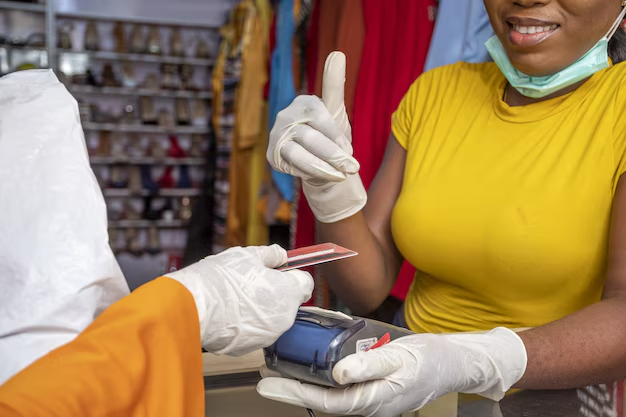
Nigeria’s financial landscape is changing fast. Point of Sale, or POS, terminals, first introduced in the early 2010s as payment tools for businesses, have become ubiquitous cash dispensers on street corners, at market stalls, and under bright umbrellas across cities and communities. This shift reflects more than convenience; it reveals deep stress points in how Nigerians access money, how banks behave, and how ordinary people navigate daily life amid economic instability. According to multiple industry sources, POS terminals now vastly outnumber traditional Automated Teller Machines (ATMs), with millions active nationwide, while ATM usage and relevance have stagnated or declined.
This story begins with a simple, provocative observation posted on X by Mimi Yaki:
“POS was introduced to help businesses receive payments. Somewhere along the line, Nigeria flipped the script. ATM failed. POS stepped in. And access to cash quietly became a business.” @Mimi_yakigar
Mimi’s words capture an ambivalence felt by many Nigerians. On the surface, POS connectors have filled a gap left by failing ATMs. But beneath that is a deeper frustration with how financial innovation, meant to simplify commerce, has become a stopgap for structural problems that continue to worsen. Millions of citizens now treat POS not just as a payment device, but as a primary way of withdrawing physical cash. What was meant to support commerce is, in the eyes of many, now sustaining a parallel ecosystem of cash extraction and entrepreneurial survival.
A National Debate Over Purpose and Practice ( Comments on X)
Responses to Mimi’s post reveal intense disagreement, yet a shared emotional core: frustration, resignation, and the desire for a functioning system. One commenter, @AkanPatrick1, wrote:
“I don’t care how many jobs the POS business have created for people, if I had my way, I will put an end to it.” @AkanPatrick1
I don't care how many jobs the POS business have created for people, if I had my way, I will put an end to it.
POS was meant for businesses to receive payment from clients and customers, but banks – due to their greed- saw another avenue to extort people. So they shut down or…
Akan’s view is blunt, but it reflects a sentiment shared by many ordinary users who see POS services less as financial inclusion tools and more as a symptom of systemic failure. He continues:
“POS was meant for businesses to receive payment from clients and customers, but banks — due to their greed — saw another avenue to extort people.”
Here, Akan is tapping into a broader experience of everyday Nigerians: when formal institutions falter, informal systems fill the void, and the emotional, financial, and social costs often fall unevenly on those least equipped to bear them. His account acknowledges rural advantages in POS access but criticises the failure of banks and the government to use that same opportunity to build functioning and equitable infrastructure.
Adding to the critique, @lionhead_king commented:
“The system is confused, pushing for a cashless economy while banking networks remain unreliable. By choking cash supplies to ATMs, they’ve forced cash to come at a premium.” @lionhead_king
The system is confused, pushing for a cashless economy while banking networks remain unreliable. By choking cash supplies to ATMs, they’ve forced cash to come at a premium. If ATMs actually worked and increased in number, the POS business would die a natural death.
Lionhead’s post highlights a critical contradiction in Nigeria’s financial policy. The Central Bank of Nigeria began promoting a cashless policy in 2012 with the hope of reducing the volume of physical currency in circulation and encouraging digital payments. Yet implementation has been uneven, and frequent cash shortages have left many Nigerians reliant on POS terminals to access basic funds. Cashless policy advocates argue that digital payments broaden financial inclusion, while detractors note that limited ATM access and unreliable networks make digital banking difficult for many — particularly elders, women in rural markets, and low-income traders.
Another voice, @EngrRedox, connected this reality to unemployment:
“However, the real ‘truth at a time’ is that POS business thrived and became lucrative as a result of the high rate of unemployment in Nigeria. Most of the operators are graduates of tertiary institutions who could not find a job but had to survive somehow.” @EngrRedox
However, the real "truth at a time" is that POS business thrived & became lucrative as a result of the high rate of unemployment in Nigeria. Most of the operators are graduates of tertiary institutions who couldn't find a job but had to survive somehow. Very unfortunate, though!
Here, the POS terminal is more than a cash source; it is a lifeline for young people with university degrees but no formal employment. Nigeria’s youth unemployment rate has been historically high, and reliance on informal entrepreneurship is one way young adults avoid desperate alternatives. Many see POS operations as a necessary adaptation to weak labour markets and limited economic opportunities.
Another commentary by @OmotoeshoTHE2nd pointed the finger at banks:
“ATM didn’t fail, the banks just grew greedy. And when I say the banks, I mean Brick and Mortar banks. And yes! The fintechs who were predominantly online banks introduced these services.” @OmotoeshoTHE2nd
ATM didn’t fail, the banks just grew greedy. And When I say the banks, I mean Brick and Mortar banks. And Yes! The fintechs who were predominantly online banks introduced this services.
— Oduduwa’s 1st Born..⚔️🐆Omo Babayo (@OmotoeshoTHE2nd) January 24, 2026
Omotoesho’s sentiment mirrors the frustration many feel toward traditional banks, especially when technology companies like Opay, Moniepoint, and PalmPay expanded agency banking networks aggressively to reach underserved communities. Banks and fintechs now co-exist in a complex ecosystem, but the shift away from physical banking infrastructure has left some customers feeling abandoned.
Lastly, @truebenny001 coined a phrase that resonates with underlying social critique:
“I call it the Nigerian Dilution Factor (NDF). The NDF is defined as the extent to which a piece of information, technology, system, operation, innovation, lifestyle, or other aspect of advanced intelligence, needs to be dumbed down to fit into the Nigerian society!” @truebenny001
I call it the Nigerian Dilution Factor (NDF).
The NDF is defined as the extent to which a piece of information, technology, system, operation, innovation, lifestyle, or other aspect of advanced intelligence, needs to be dumbed down to fit into the Nigerian society!
This comment is not a light remark. It expresses emotional fatigue with a pattern many Nigerians recognise: innovations introduced with promise devolve into versions that feel dysfunctional or exploited. This “dilution” speaks to social adaptation under inequality — when systems that should empower become burdensome, people learn to cope rather than prevail.
What the Data Shows
Beyond personal testimonies, a growing body of research and reporting confirms the scale and complexity of this transformation. Multiple sources find that Nigeria’s POS terminals have proliferated far beyond initial expectations, skewing heavily into cash withdrawal services rather than simply point-of-sale payments. According to a financial report, POS agents handled transactions valued at far higher totals than ATM withdrawals, reflecting dramatic growth in daily usage.
Another industry analysis found that as of early 2025, there were millions of active POS terminals compared to only tens of thousands of ATMs, highlighting an imbalance in cash access infrastructure. This gap has shaped citizen behaviour: many now use POS outlets as their primary sources of cash, even if fees are high.
Economists and financial inclusion researchers note that POS agents have played a significant role in bringing basic banking services to underserved populations. A study on rural financial access found that POS operators reduce travel time for cash services, decrease reliance on distant banking branches, and create jobs in remote areas. These findings reflect the positive side of agency banking and the potential for technology to reach populations that traditional banking has overlooked.
The Emotional Stakes for Everyday Nigerians
Behind every statistic are real pressures on families and small businesses. Traders in open markets depend on cash transactions for daily revenue. Transport workers need cash to pay fares and fuel expenses. Older citizens may find digital apps confusing or inaccessible. When cash-out options fail or cost extra, it is not just an inconvenience; it can mean missed meals, lost customers, and deepened mistrust in formal systems.
When POS agents are the only reliable conduits of cash, every withdrawal becomes a negotiation with cost and convenience. Many complain of high fees that feel exploitative when multiplied daily across households struggling to make ends meet.
Expert Perspectives and Policy Challenges
Financial analysts emphasise that POS terminals were part of a broader strategy to increase financial inclusion, not to replace core banking infrastructure. According to a central banking policy review, increasing digital payment options helps reduce the risks and costs of handling physical currency and brings more Nigerians into the formal financial system.
However, experts also point out that policy design and implementation must be aligned with infrastructure development. For POS terminals to function effectively as access points for cash and transactions, reliable network connectivity, security frameworks, and consumer protections are essential. Without these, both users and agents face risks such as fraud, data theft, and uneven service quality.
Nigerian financial regulators have taken steps to address some of these issues, including sanctioning banks for failing to ensure the availability of cash at ATMs and exploring regulatory frameworks for POS agents to operate transparently and securely. Yet many Nigerians still see these measures as too little, too late in addressing daily frustrations with cash access.
Conclusion
Nigeria’s financial landscape is not broken because innovation exists. It is stressed because the growth of technology outpaced the development of equitable infrastructure and policy support. POS terminals have become a lifeline for many, but reliance on them must not obscure the need for a balanced, functioning system where ATMs, bank branches, digital channels, and agents work in concert.
Experts urge that banks increase ATM deployment and maintenance in underserved areas and that regulators strengthen protections for users of POS services to curb exploitative fees and fraud. Efforts to improve network reliability, financial literacy, and security frameworks would help empower citizens and restore confidence in formal financial systems.
For everyday Nigerians, the advice is pragmatic: use multiple channels for cash and payments; register complaints with financial institutions and regulators when services fail; and support community-level financial literacy initiatives that help people navigate digital banking safely and effectively. With sustained policy alignment and public engagement, the promise of financial inclusion can finally catch up with the lived realities of millions across the country.