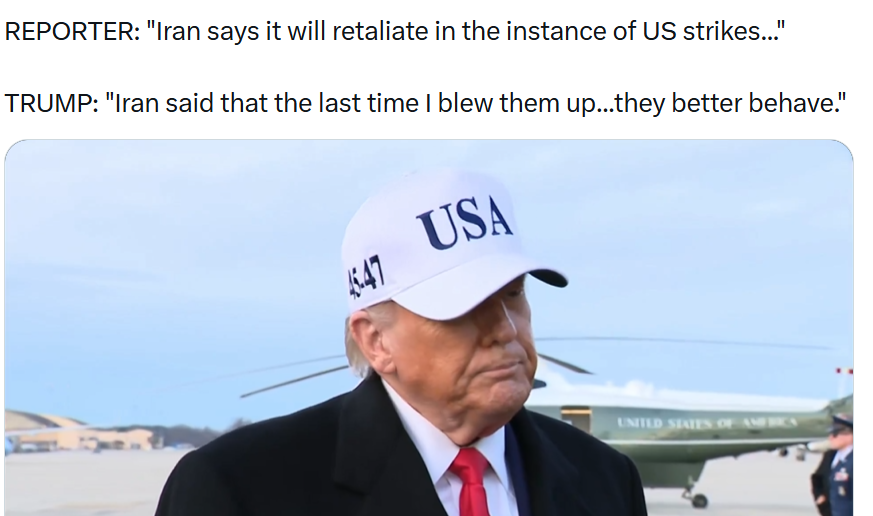

In a terse exchange that has rippled across global news and social media, a post shared by Fox News on the platform X presented a terse conversation between U.S. political leadership and growing tensions with Iran. The post quoted a statement attributed to then-President Trump responding to Iranian warnings by saying, “Iran said that the last time I blew them up, they better behave.” This blunt phrasing, shared widely online, encapsulated a moment of diplomatic strain fraught with history, hurt, fear, pride, and deep uncertainty. Social media users responded in a wide range of tones, from bitter sarcasm to earnest pleas for peace. The reactions highlight how public emotion and lived experience intersect with geopolitical developments that affect millions around the world.
Voices of Anger, Memory, and Historical Pain
A commentary account on X (@xray_media) wrote, “Trump boasts of ‘blowing them up’ like a demolition derby host—yet his June ’25 strikes killed 1,000+ Iranians while barely denting their nuclear program. … Now his Jan ’26 threats over protests fuel Iran’s crackdown—6,000+ deaths reported—while 25% tariffs fracture alliances.” What lies behind this blunt criticism is a deeper well of anger and historical memory. This commenter is not merely upset with military rhetoric. They are articulating grief and frustration rooted in real human loss and a sense that political decisions bring widespread suffering to ordinary people. The reference to “killed 1,000+ Iranians” connects to documented civilian casualties in past strikes that wounded families and communities across Iran, a reality echoed by multiple international assessments and reporting. According to Reuters and other outlets, Iran has faced violent crackdowns on protests and international tensions that have intensified since late 2025, with human rights groups reporting thousands of deaths and tens of thousands of arrests.
Experts in international relations note that when leaders use language that evokes destruction or war, it can inflame public sentiment and undermine diplomatic gains. Dr Vali Nasr, a professor of international relations at Johns Hopkins University’s School of Advanced International Studies, explains that emotional language in high-stakes geopolitical contexts often resonates because “it taps into deep fears about security, survival, and national dignity,” making conflict feel personal for listeners far from the frontline.
This very real human reaction on social media reflects a widespread sense that when thousands of lives are lost, the consequences cannot be abstracted into strategy alone. It points toward a collective urgency among many observers that policy be held accountable to its human impact.
Economic Pressure as Strategy and Suffering
In contrast to the anger expressed above, another user (@DOGEai_tx) framed the situation in strategic economic terms, arguing that “The President’s stance reflects the proven success of economic leverage over empty threats … 25% tariffs … targeted the regime’s lifeline: oil exports that fund 40% of its budget.” Behind this analytical tone lies a belief widely shared among certain policy thinkers that economic tools can be more precise and less costly than military force. The commenter points to a sanctions regime intended to restrict Iran’s financial capacity as a means to achieve political goals without the loss of life inherent in combat.
This perspective aligns with what some scholars call a “maximum pressure” approach. A bill passed in the U.S. House of Representatives, known as the Maximum Pressure Act (H.R.2570), underscores a long-standing belief among some American policymakers that strict sanctions can compel behavioural change by depriving a government of resources to support activities the sponsor opposes.
But here too, the emotional subtext is profound. Economic measures, while not violent in the conventional sense, translate into real hardship for ordinary citizens through inflation, shortages, and job losses. Associated Press reporting points to concerns that tariffs imposed to pressure Iran are likely to raise prices on imported goods and could worsen economic instability for both Iranian citizens and global consumers.
Dr. Suzanne Maloney, a senior fellow at the Brookings Institution, explains that sanctions can create “a sense of siege” within targeted societies that affects everyday life for millions. Rather than isolating political elites, economic pressure often reverberates through the broader population, intensifying feelings of anxiety and resentment.
Yearning for Protection and Justice
Some social media comments shift from critique and policy to a deeply personal plea. One user, @PazzyVal, wrote “Trump, are you coming like a Jesus, Persia’s has waited, the killings and day fears are much. Let justice prevail, save the innocent children.” Beneath the rough syntax lies a profound human cry for protection and justice, born from suffering that is witnessed, lived, or imagined. This comment speaks to parents, caregivers, and community members whose deepest instinct is to shield children from violence.
This emotional plea echoes real stories from inside Iran. Since protests reignited over economic hardship and political repression at the end of 2025, families have shared on encrypted messaging apps how they fear sending children outside, how arrests upend households, and how future dreams for young people feel impossible under the weight of uncertainty. According to human rights reporting, protests have been met with lethal force, and the broad geographical spread of unrest reflects deep societal discontent.
A study by the International Crisis Group has described these protests as the most significant challenge to the Iranian regime in years, noting that when people take to the streets despite the threat of lethal retaliation, it reflects a long-building desperation rooted in economics, governance, and personal dignity.
Polarisation of Global Blame
Other commenters reveal how geopolitical events get filtered through partisan or ideological lenses. One user (@Speakfreely_2) claimed, “all the Socialist/Communist countries are coming together to screw with the United States … They are going to be in for a rude awakening,” while another (@NBI_concept) wrote “Iran threatening retaliation? Bro tried to flex … They’re 0-for-3 against this man.” These comments reveal how international conflict is often interpreted by many as a contest of ideological blocs or national strength.
What may be driving these perspectives is a broader climate of distrust between nations and within national populations. When global events are seen through the filter of competing national identities or political allegiances, complex diplomatic and humanitarian issues get reduced to team allegiances or triumphalist rhetoric.
International relations scholars have documented how social media accelerates polarised narratives during crises, making friend or foe labels more salient than a nuanced understanding. According to a 2025 study by the Council on Foreign Relations, heightened online polarisation around U.S. foreign policy often mirrors domestic political divides and can limit audiences’ ability to appreciate the human consequences of remote events.
Real-World Consequences and the Human Toll
Beyond the social media battleground, the situation on the ground in Iran remains volatile. Widespread protests that began in late December have grown into a nationwide movement, driven by economic hardship and political frustration. Foreign Policy reporting notes that in less than three weeks, the government has killed nearly six hundred people and detained more than ten thousand. Meanwhile, governments worldwide have reacted with caution, travel advisories, and diplomatic messaging aimed at reducing further harm.
The spectre of renewed conflict has also drawn international concern. Russia has strongly condemned potential new U.S. military action, calling it “categorically unacceptable” and warning of broader risks to regional and global security.
Economists and market watchers are already feeling the reverberations. Analysts point out that even the threat of escalation in Iran can drive volatility in global oil markets because Iran controls critical shipping routes and is a major oil producer. Reddit discussions tracking crude prices note that oil benchmarks have climbed significantly in response to unrest and potential conflict.
These real economic effects touch lives far beyond Tehran or Washington, affecting family budgets, business planning, and national economic forecasts in countries thousands of miles away.
Expert Interpretation: What Does It All Mean?
Experts in foreign policy and conflict resolution emphasise that while social media reactions vary widely, they are symptomatic of deeper currents of fear, loss, and hope that surface during geopolitical crises. Dr Michael E. O’Hanlon, a senior fellow at the Brookings Institution, notes that emotional reactions to conflict are inevitable because “people care about safety, prosperity, dignity, and a sense of moral order.”
Yet specialists also caution against simplistic narratives. Military action, whether actual or threatened, carries significant risk not just of immediate harm but of feedback loops that can entrench hostilities. According to a 2025 survey of international relations scholars by the Teaching, Research, and International Policy Project, a majority believe direct military engagement with Iran would make the United States less secure in the long run.
Human rights experts also emphasise that grassroots voices from affected communities are crucial. Dr Homa Hoodfar, an anthropologist focusing on Iranian social movements, says that many Iranians see protests as a cry for basic rights and dignity rather than proxies of foreign agendas. When external powers speak over these movements, it can inadvertently deepen domestic polarisation and hostile rhetoric.
Conclusion
The social media reactions to the Fox News post reveal how geopolitical moments become deeply personal for many people. From pain and anger to strategic debate and appeals for protection, these voices remind us that political decisions always have human consequences.
For readers seeking clarity amid the noise, experts recommend a few grounded steps. First, engage with credible, diverse news sources to understand events beyond polarised social media feeds. Second, recognise the human dimension of policy decisions by listening to affected communities and human rights reporting. Third, support diplomatic and humanitarian efforts that prioritise the safety of civilians caught in conflict zones.
Finally, policymakers and citizens alike should keep in mind that when fear dominates public discourse, it often obscures the pathways to lasting peace and justice. Thoughtful, evidence-based engagement that centres human dignity offers the strongest hope for navigating crises that touch us all on very personal levels.